
Big Impact, Small Space: How to Choose Art That Makes Your Room Feel Designed (Not Crowded)
Published: 15 September 2025 • Reading time: ~6–7 minutes
Tiny room, giant personality? Same. The trick with small spaces isn’t playing it safe—it’s choosing art that earns its spot. Here’s how to make your walls feel curated (not cluttered) with pieces that spark joy every time you walk past the kettle.
1) Start with mood, not measurements
Before you grab a tape measure, name the feeling you want when you walk into the room—calm, cosy, energised, playful. Your mood decides everything else: colour palette, subject matter, even frame style. If “calm” is your north star, look for softer palettes and gentle movement; if you want energy, lean into bold contrast and dynamic brushwork.
2) Size rules that actually work
-
Over furniture: Aim for art that’s ⅔ to ¾ the width of the furniture beneath it (sofa, console, bedhead).
-
Eye level matters: Hang so the centre sits ~145 cm from the floor (gallery height).
-
Spacing: Keep 5–8 cm between frames in a set so the group reads as one statement, not visual confetti.
-
One big vs many small: In tight rooms, a single larger piece often feels cleaner than a scatter of minis.
3) The paper cut-out
Blue‑tack butcher’s paper or newspaper at the sizes you’re considering in the space you would like to add a painting to. Live with it for a day. You’ll instantly feel whether you need bigger, taller, or a two instead of one.
4) Colour that plays nice
Borrow two or three colours already in the room—cushions, rug, bedding—and let your art bridge them. A piece with a whisper of the sofa colour plus a pop from the rug will pull the whole space together. Not matching, just rhyming.
5) Frames do heavy lifting
-
Frames in natural timber, white or pale oak feel airy and add a beautiful finishing touch to any artwork.
-
Mat boards for fine art prints add breathing room—great for busy scenes or smaller works.
-
Black frames are crisp but can feel heavy in very small rooms—balance with lighter textiles.
6) Layouts for small rooms
-
Statement piece: One statement work above the sofa, bed or kettle in the kitchen.
-
Diptych energy: Two verticals side by side tighten a narrow wall.
-
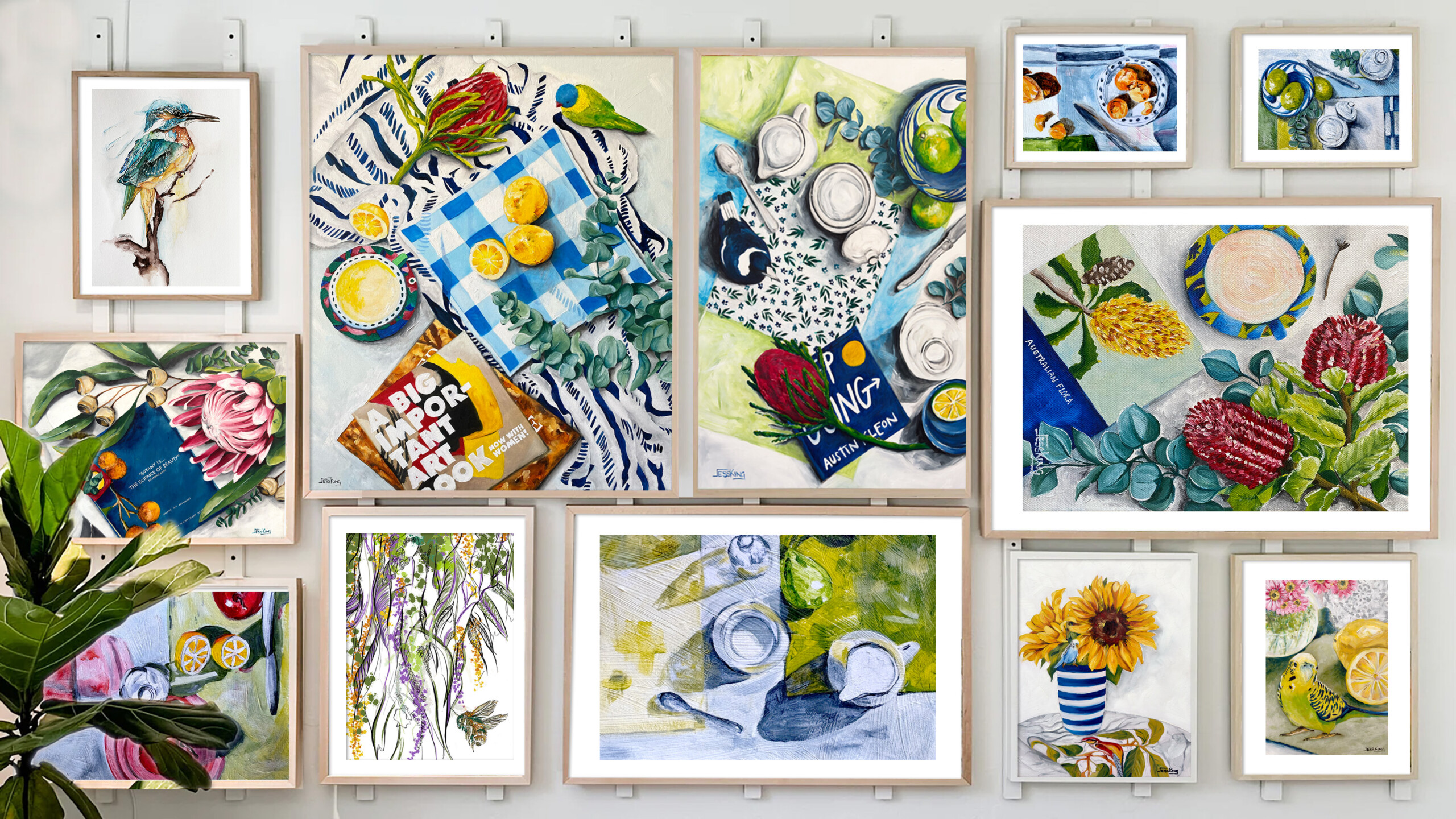
Mini gallery: 3–5 pieces in a tidy grid for maximum polish. Depending on your style you might like an eclectic mix instead of using the same frame for all.
7) Originals, limited editions, or prints?
-
Originals: Texture, soul, one‑of‑one. Choose these for the hero spot.
-
Limited edition prints: Best value‑to‑impact ratio; numbered and signed, so they still feel special.
-
Open edition prints: Budget‑friendly, perfect for gallery walls or rentals or for the art lover who wants to refresh more often.
Ready to test‑drive the look? Explore my limited edition pieces for statement spots, then pair them with open edition prints to finish your wall without blowing the budget. If you’d like a second eye, send me a quick photo of your space—I love helping pick the perfect piece.
Frequently Asked Questions
Q: What size artwork works best in a small room?
A: Counter-intuitively, one larger piece often feels cleaner and less crowded in a small room than several small works. As a rule of thumb, art above furniture should be roughly two-thirds to three-quarters the width of that furniture. Going slightly larger than feels comfortable is usually the right call — small art on a large wall gets lost.
Q: How high should I hang art on a wall?
A: The standard gallery height is to hang artwork so its centre sits approximately 145 cm from the floor. This works in most rooms and aligns with average eye level. If you’re hanging above furniture, adjust so there’s 15–20 cm between the top of the furniture and the bottom of the frame.
Q: How much space should there be between artworks in a gallery wall?
A: Keep 5–8 cm between frames in a grouped arrangement. This distance allows the works to read as a cohesive set rather than isolated pieces scattered across the wall. Consistent spacing is more important than consistent frame style.
Q: Should I use one large piece or several smaller ones in a small space?
A: In most small rooms, a single statement piece creates more visual calm than a cluster of smaller works. Multiple small pieces can feel busy in a confined space. If you want more than one work, try a tightly spaced pair (a diptych) rather than a full gallery wall.
Q: How do I test whether an artwork will suit my wall before buying?
A: The paper cut-out method is the most reliable test: cut newspaper or butcher’s paper to the size you’re considering and blue-tack it to the wall. Live with it for a day. You’ll immediately feel whether the scale is right. I also offer free digital room mockups — send me a photo of your wall and I’ll show you any piece from my collection in your space.
Q: What frame style works best in a small room?
A: Natural timber, white, or pale oak frames tend to feel the most airy and least heavy in small spaces. Black frames are crisp and contemporary but can feel dominant in a very small room — balance them with lighter textiles. Mat boards add breathing room to prints and work particularly well for detailed or busy compositions.
Q: What’s the difference between an original, limited edition print, and open edition print for home display?
A: An original painting has hand-applied texture and exists once — ideal for a hero wall position. A limited edition print is a high-quality reproduction made in a fixed numbered run, signed by the artist — the best value-to-impact option. An open edition print is the most budget-friendly and works beautifully in gallery walls or rental spaces where flexibility matters.